Patents vs. Trade Secrets: How to Protect Your Core Tech Without Slowing the Roadmap
L. Jon Lindsay, Partner
September 29, 2026
Sometimes you have to ask yourself, “Should I file a patent application for this, or should I keep it as a trade secret?” If it provides any competitive advantage, then a patent or trade secret should be considered.
Patents are usually best when the invention is detectable, reverse-engineerable, or commercially visible, or when it is likely that someone else could independently reinvent the same solution. Trade secrets are generally best when the invention is hidden and never disclosed, hard to reverse engineer, and long-lived.
Investors typically prefer patents, because patents are transferable and enforceable assets. Trade secrets, on the other hand, can be independently reinvented by someone else, can sometimes be reverse engineered, are harder to license, and do not appear on balance sheets as clearly as a patent.
Patents are typically stronger when secrecy is fragile or impossible, because if someone can buy, inspect, or analyze your product and figure it out, then trade secret protection could eventually fail. Examples of products that can be reverse engineered may include:
Mechanical devices,
Consumer electronics,
Semiconductor layouts (often),
Chemical compositions (that can be analyzed),
Medical devices, and
Manufacturing equipment (sold to customers).
In other words, if a competitor can lawfully acquire it, analyze it, and reverse engineer it, then it is better to patent the invention. Additionally, if it is likely to eventually be disclosed publicly, then it is best practice to patent it before the disclosure. In an obvious example, if you are going to give a conference presentation with details about a product or service, then this is clearly not keeping it as a secret, so a patent would be the only option.
Any features that are visible to customers or competitors or that are observable when operated or used are difficult or impossible to keep secret, so a patent is again the only option. Some examples might include:
UI/UX features (buttons, layouts, and navigation that enhance user interaction and experience with a product or website);
Product architecture;
Circuit configurations visible on a PCB;
Observable behaviors of drones or robotics;
Algorithms inferable from the inputs and outputs; and
Business methods exposed by using a service.
Even if secrecy is possible, core differentiating technology with high commercial value is often worth patenting if the invention:
drives valuation of a product, service or business;
attracts investors;
creates licensing opportunities; or
defines market position.
Also, a patent might be better if it were likely that a competitor would independently reinvent the same solution when faced with the same problem. Some examples where this could potentially happen can include:
AI techniques;
Battery chemistry improvements;
Semiconductor process tweaks;
Networking protocols; and
Software optimization methods.
With respect to potential licensing, patents are more practical for royalty revenue, cross-licensing, defensive portfolios, and acquisition valuation. Trade secrets are hard to license because they must be revealed in order to be licensed, the licensee might leak the information, and enforcement is difficult.
Another consideration is that a trade secret is typically not maintained in such a way that the person who invented it can be given credit for their hard work. A patent, on the other hand, clearly shows who was involved in the invention and can be used as part of a reward or recognition program.
Most of the foregoing might suggest that patents are better than trade secrets. However, trade secrets may be preferred when secrecy is sustainable and long-term. For example, things hidden inside manufacturing procedures, business operations, or cloud-based software might never be accessible by customers or competitors, so such things are typically not available to be analyzed or reverse engineered. In other words, if the public never sees it, cannot analyze it, and is unlikely to independently develop it, then a trade secret is the better option. Some examples could include:
Software as a Service;
Manufacturing processes;
Chemical processing conditions;
Yield optimization methods;
Factory calibration techniques;
Internal testing procedures; and
Supply chain methods.
An algorithm or model that runs on a server (e.g., the cloud) is a significant example where a trade secret might be preferable, because users cannot access the underlying software. Some examples may include:
Search ranking algorithms;
Fraud detection models;
Ad targeting systems;
Trading algorithms;
AI model training methods; and
Internal data pipelines.
In other words, if it never leaves your server and cannot be inferred, then a trade secret often beats a patent. This is because there is no disclosure requirement, the protection lasts indefinitely, and it avoids enabling competitors via a patent publication.
A classic example is the Coca-Cola formula. If it had been patented, then the patent would have expired long ago, and then anyone could have copied it from the patent disclosure. However, the trade secret has lasted for more than 100 years.
Additional examples of the types of material that might be better for a trade secret are know-how and “secret sauce”. Some examples can include:
Parameter tuning;
Process recipes;
Data curation methods;
Vendor selection logic;
Experimental insights; and
Knowledge gained in failure.
These are often not discrete inventions, so they can be hard to define in a patent but are sometimes easy to keep confidential and extremely valuable.
Furthermore, if a patent would be narrow and easily avoided by a simple design around, then a trade secret may be better. In other words, if competitors could easily avoid infringement, then it might be better to keep it secret instead of teaching them how to do it. Some examples can include:
Slight manufacturing tweaks;
Minor algorithmic improvements; and
Specific parameter ranges.
When a disclosure by a patent would teach competitors too much, a trade secret might be safer. A patent is a publication, which could potentially reveal a system architecture, a business strategy, a roadmap, or key optimization insights. This can be a problem for:
AI systems; Security systems;
Data pipelines;
High-speed trading; and
Detection/anti-malware techniques.
Furthermore, the cost to obtain a patent is typically $20,000 to $50,000 at MLO. The cost of a trade secret, on the other hand, is primarily the inconvenience of having to ensure that everyone knows to keep the secret. A best practice is also to document trade secrets in an internal disclosure document as well.
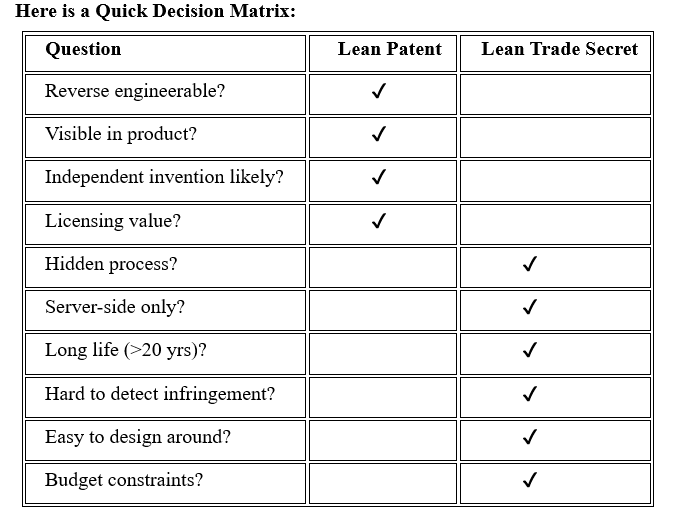
An important strategic question you can ask yourself is “If I disclose this in a patent, do I gain more protection than I lose?” If disclosure helps you more, then a patent would be better. If disclosure helps your competitors more, then a trade secret would be better.
Finally, the decision about whether to file a patent for something should be made as early as possible, so there will be time to prepare and file the patent application before product launch or a public disclosure. If you would like help evaluating what type of IP is the best fit for your company, MLO is here to assist.