Open Source Without the Headache
Heather Slotnick-Firm Managing Partner
June/22/2026
Open‑source software powers modern products, accelerating development and reducing costs. But while open source is free to use, it is not free from legal IP risk. The key is not avoiding open source—it is using it deliberately.
The smartest organizations start with visibility. Open‑source due diligence means knowing what code is in your product, where it came from, who licenses it, and whether the license is permissive or copyleft. Without this baseline, companies risk surprise disclosure obligations, security issues, and painful remediation during audits, customer reviews, or acquisitions.
One of the most overlooked risks arises when teams directly improve open‑source code inside the product: many licenses—especially copyleft licenses—require that derivative works or improvements be licensed back to the community as open source. This can unintentionally donate proprietary enhancements (i.e., your IP) to the community.
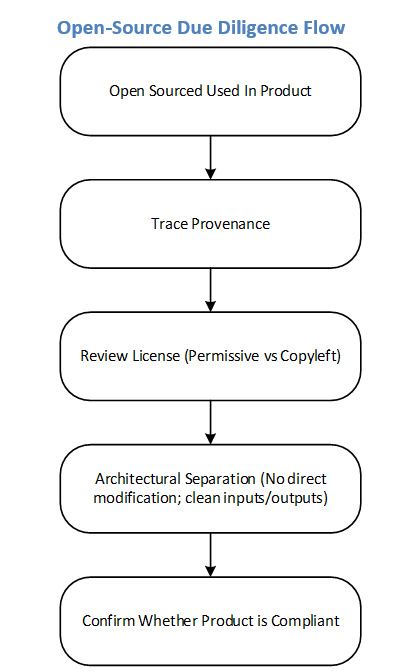
Best practice is to (i) review the open-source license details and (ii) if available in that license, perform architectural separation. Rather than modifying open source directly, treat it as a separate module. Run it as a service, engine, or utility with clean input/output boundaries. With this approach (assuming the license supports it!), your proprietary value remains in your own code, while the open‑source component does what it does best—without infecting your IP by putting it in the public domain.
With thoughtful governance and clean system design, open source becomes a competitive advantage instead of an IP liability.
Quick Process Checklist
Identify & Inventory all open‑source code (direct and indirect dependencies): preferably early in the process or event better, before adaptation. Consider using a highly rated tool like Syft by Anchore or Trivy.
Trace Sources: note source repository, maintainer, and activity status.
Review Licensing: who licenses it and whether terms are permissive or copyleft. Consider using an attorney for this step.
Apply Architectural Safeguard which are often available: do not modify—use as a separate module with clean I/O and document in your Inventory.
Establish Ongoing Governance: a process with ownership, monitoring, and pre‑release reviews.
Need more assistance? Reach out to MLO for a complementary general session on reducing IP risk associated with using open source.